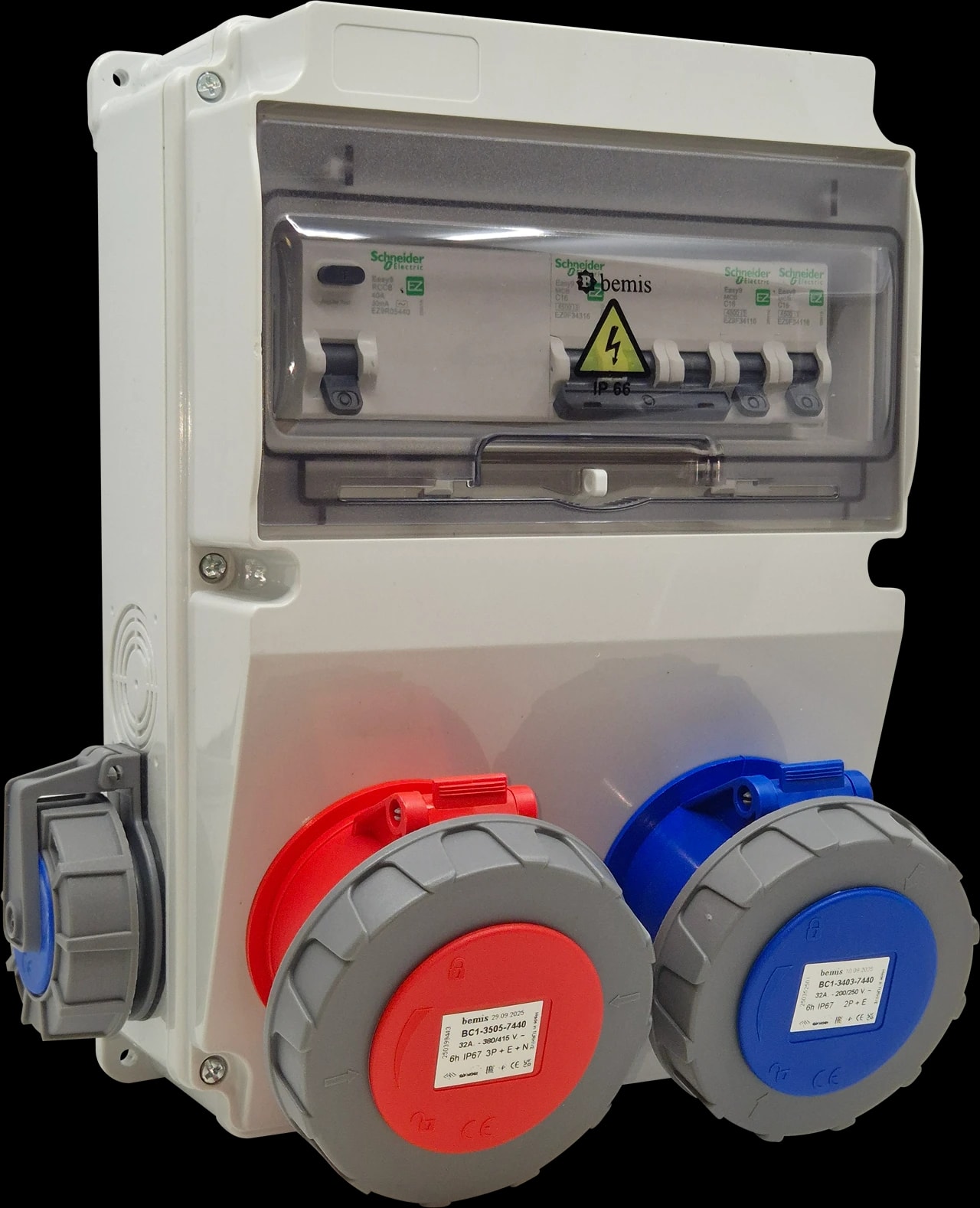
IP66 Combination Unit with MCB 5/32A · 3/32A 220V · 1/16A
This version: 5/32A 1pc Pre - 3/32A 220V 1pc Front - 1/16A 1pc Side · one of 3 versions
Combination unit with automatic in IP66 protection class. It provides protection against full dust and strong water jets; for outdoor, seaside and industrial site installations.
Frequently Asked Questions
What does the Charger Equipment category include?
It includes the professional equipment used in charging station installations: AC and DC charging sockets (Type 2, CCS2), tethered and socketed versions, socket covers, locking mechanisms, optional communication modules and spare parts that can be integrated into a charger. It is used by OEM manufacturers and service providers.
What is the difference between a DC charging socket and an AC charging socket?
AC sockets (Type 2) carry alternating current up to a maximum of 22 kW and have a simple construction. DC sockets (CCS2) carry 50-350 kW of direct current and contain liquid cooling, temperature sensors and thicker conductors. DC sockets are 3-4 times heavier and require special installation.
What does an operator need to set up a charging station?
A transformer connection or sufficient subscribed power, chargers supporting OCPP 1.6J/2.0.1, CPO software for billing and management, and an EPDK licence or a dealer agreement are required. Our Bemis B2B team supports product selection and hardware supply; installation and commissioning are the buyer's responsibility and are carried out in line with the Bemis Installation Procedures.
What is a CCS2 socket?
Combined Charging System 2 (CCS2) is the DC fast-charging standard of the European market. It is a combined design that adds two extra DC pins below the Type 2 AC connector, so both AC and DC charging can be done through the same vehicle socket. It supports power between 50 and 350 kW.
Can a spare socket or cable be replaced?
Yes. The cables and sockets of our Bemis chargers are modular in design; in the event of wear or damage, our authorised service can replace them quickly. We keep stock of special parts such as liquid-cooled CCS2 cables.
Related Products